Automotive
Brand Valuation for an Automotive Technology Supplier


Rethinking UX Research for Enterprise Product Teams
You’ve been there before. Your team spends weeks (maybe months) polishing a new feature for your B2B platform. You run the tests. Users nod along in Zoom calls. Feedback looks positive. You ship.
And then… nothing.
Adoption stalls. Usage flatlines. That “killer feature” quietly fades into the background.
The uncomfortable truth?
Why? Because traditional UX testing often misses the messy, political, real-world context of enterprise software. Let’s break down the most common traps-and how you can avoid them.
Enterprise users are polite. They’ll say, “Yeah, that’s useful,” during testing. But when the feature rolls out, they never touch it again.
Why it happens: You tested intent, not behavior. A feature only sticks if it saves time, improves reporting, or directly supports KPIs.
How to fix it:
Most usability tests look like this: log in → complete a task → done.
But real life? Users get interrupted. They switch tabs. They delegate. They wrestle with internal tools and approval chains.
Result: Something that worked beautifully in a neat test session might collapse in the chaos of daily workflows.
Better approach:
Here’s the kicker: the person using the feature isn’t always the one approving it-or paying for it.
Consequence: Your feature wins over end users but dies in procurement, IT, or management reviews.
Fix:
Yes, people can use your feature. But will they? Adoption depends on motivation: does it help them hit KPIs, look good to their boss, or make their life easier?
So instead of only asking: “Can they use it?”
Also ask: “Why would they bother?”
Bring in principles from behavioral economics-look for the incentives that drive action.
Your prototype may get the green light in testing. But what about three months later?
That’s when problems surface: unclear ownership, bad data, slow adoption. Pre-launch tests can’t always predict that.
Smarter strategy:
B2B users rarely ask for “new.” They want predictable, integrated, and reliable.
A sleek UI won’t matter if the feature doesn’t work with their spreadsheets, dashboards, or approval workflows.
Tip: Test interoperability just as much as usability. Don’t underestimate the boring but critical things-like data exports, permissions, and integrations.
At Jasper Colin, we know the real-world pitfalls of B2B UX. Our research goes beyond “does this test well?” to uncover what truly drives adoption at scale.
We blend:
The goal: helping product and UX teams build features that don’t just look good in tests-but actually get used.
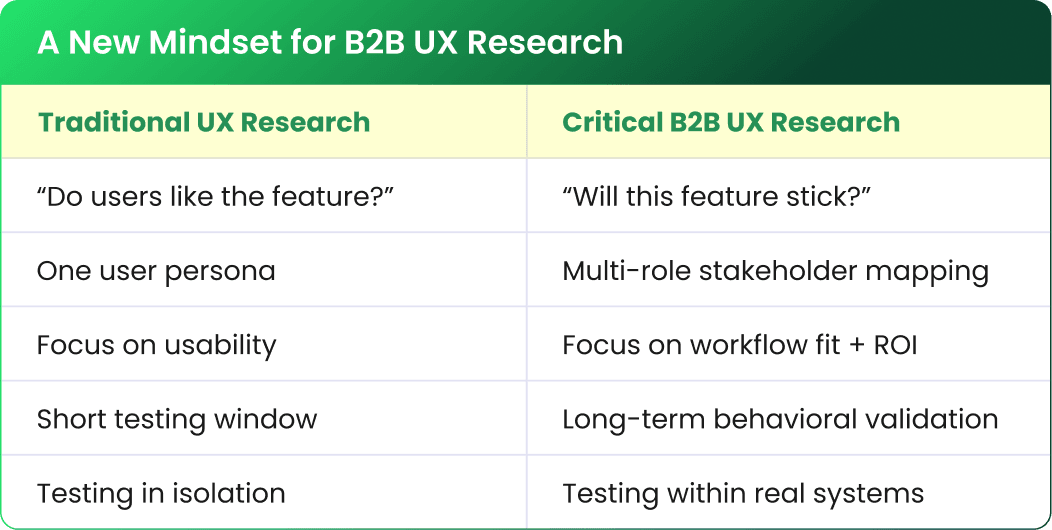
In B2B, success isn’t measured by how easy a feature is to use-it’s measured by how often it gets used, who adopts it, and what outcomes it enables.
So, the next time you’re planning UX research, ask yourself: Are we testing for usability, or for adoption?
If you’re ready to reframe your UX research strategy, let’s talk.
Brand Valuation for an Automotive Technology Supplier

Global ESG Ratings Research - Understanding How Enterprises Evaluate Sustainability Standards

Competitive Landscape Analysis of Automotive Aftermarket Spare Parts

Evaluating Online Classified Platforms in Automotive Retail