
Retail & CPG
From Product Performance to Premium Desire


Why Panels Aren't Enough Anymore By the spring of 2026, the market research landscape will no longer be characterized by the pace of data collection, but the orchestration of intelligence. The old research panel was the gold standard, a sound, representative picture of consumer sentiment, over decades.
Nonetheless, in a world where cultural changes occur in hours and mood swings alter with every news cycle, the snapshot model has become a competitive drawback. The sector is shifting away to episodic projects to a model of embedded infrastructure.
The Synthetic Revolution: The Elephant in the Room
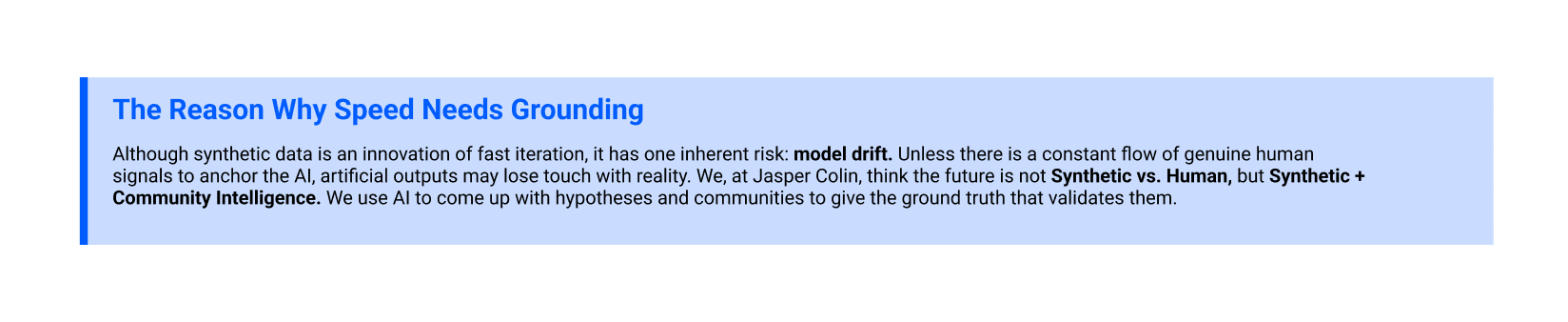
The biggest break in the conventional research is not the emergence of a novel method of recruiting human beings but the emergence of AI Synthetic Data. The question of whether synthetic responses are real enough or not is no longer a debatable issue. Recent report indicates that 72 percent of teams that apply synthetic research and agentic AI indicate that their organizations now rely on research much more than they did a year ago.
Moreover, nearly two-thirds of the researchers already use synthetic data in their processes to stress-test hypotheses and speed up early-stage discovery.
The technology has now taken a new level of localization. Numerous market research companies are now extending their synthetic consumer panels, which are being driven by fine-tuned large language models trained on hundreds of millions of data points around the globe, into the UK, Ireland, Canada, Australia, and New Zealand. This gives brands the opportunity to model Digital Twins of their target audiences in these areas, and find areas of friction in a product journey without having to engage a single human respondent.
The Nuanced Reality of Communities
Although most companies introduce the concept of insight communities as the solution to panel fatigue, a critical evaluation of the concept shows that it has its own structural risks. The use of a highly engaged community alone may result in the following biases that are documented:
Engaged Member Bias: The members of branded communities are usually self-selected champions. They are the super-user but can act systematically to overlook the silent majority or the disillusioned former customer.
The Hawthorne Effect: As the members of the community become aware that they are under observation for a period of months, their behavior changes slightly. They start acting as a good respondent instead of giving raw and instinctive feedback.
Homophily and Fatigue: Small groups tend to have similar archetypes, which reduces the ideological spectrum of views. The quality of insight may eventually level off as members get to know how to tell the brand what it wants to hear.
Re-conceptualizing Human-Led in an Algorithmic Age
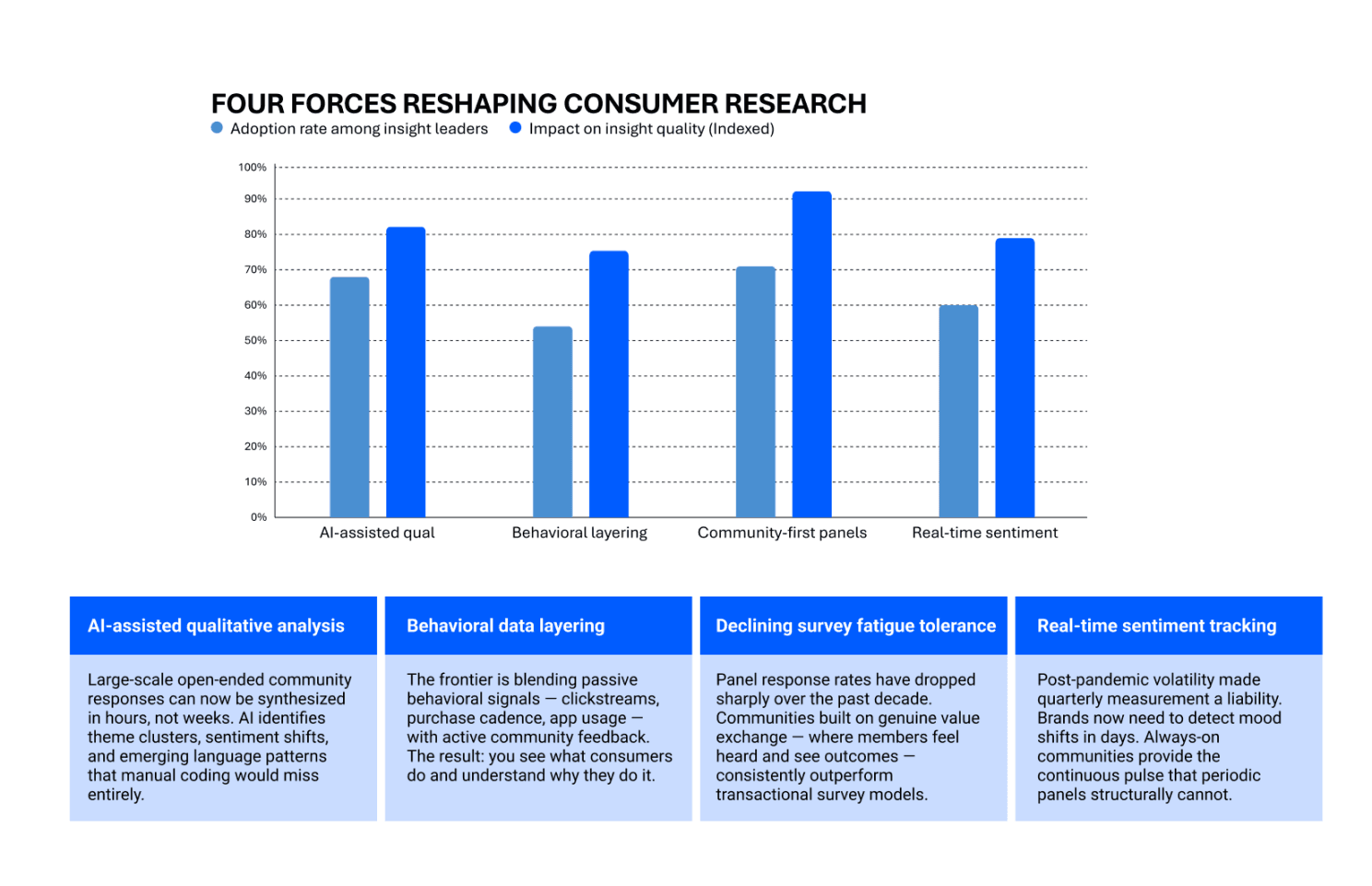
By 2026, Human-Led Research is no longer a differentiator when it merely implies that humans perform the manual coding. The role of a human has changed with the synthesis of thousands of open-ended responses in hours with the help of AI-assisted qualitative analysis. This is now the strength of the researcher in Editorial Judgment the skill to examine a synthetic simulation and a community signal and determine which one is a real market opportunity, and which one is statistical noise.
We experience a change in culture whereby research has become a project to research as infrastructure. Business intelligence systems are being incorporated into daily operations with insights being embedded into them.

Why Context Is the New Currency
Let’s break it down.
A panel may inform you: “Customer satisfaction has decreased by 10%."
But a community informs you: Why it dropped, when it dropped, what caused the drop and how it is changing.
That’s the difference between:
Data vs. Insight
Response vs. Behavior
Feedback vs. Narrative
In today’s world where trends emerge overnight and disappear just as quickly; context is everything.
The Jasper Colin Way: Research Orchestration
We have outgrown the dichotomous argument of Panels vs. Communities. In the present environment, dominant brands need Orchestration, the capacity to use the appropriate tool at the appropriate time. Jasper Colin is an expert in the integration of the two ecosystems to give a 360-degree perspective of the consumer journey.
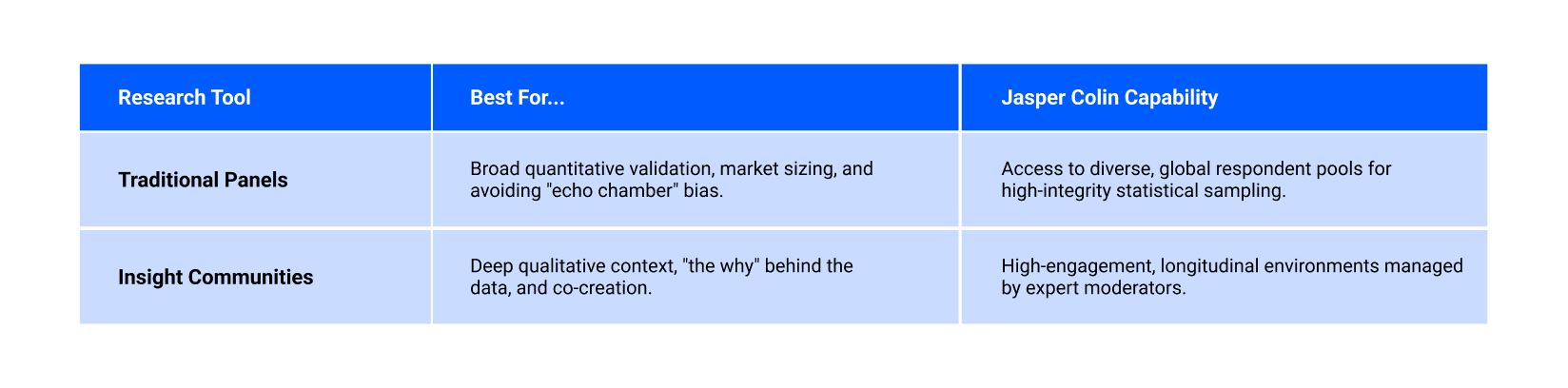
We do not believe in the one-size-fits-all research at Jasper Colin. We have three pillars of value proposition that will be developed to serve the 2026 market:
1. Seamless Multi-Channel Management
We coordinate panels and communities in one structure. This enables us to yank the lever on any methodology that will suit the short-term business goal, a 24-hour sentiment survey or a 6-month behavioral analysis.
2. Flexible, Tailored Models
The business issues you face are not the same; neither should your research model. Our bespoke research flywheels combine passive behavioral information, proactive community feedback, and wide panel validation.
3. Human-Led Intelligence
Algorithms do not provide context, even though AI has emerged. All projects of Jasper Colin are supported by well-qualified researchers. Our group does not simply present data, but digs narrative. They also know that a 10 percent decrease in satisfaction is a fact, but why the satisfaction decreased in the middle of a customer service call is an actable information.
In conclusion: Moments vs. Journeys.
Panels have been used in the industry for decades and they are still an essential tool of validation. However, depending on them in 2026 causes an institutional blind spot. The most significant consumer changes occur between the surveys- in the aisles, in the one-on-one discussions, and in the changing digital behaviors.
Whether your consumers have changed is not the question of the brand leaders today. Of course, they have. The real question is: Does your research model have the flexibility to find out why before the window closes?
At Jasper Colin, we don't just capture moments. We understand the journey.
From Product Performance to Premium Desire

White Space Exploration: Unlocking the Next Frontier of Growth in Emerging U.S. Consumer Markets

Understanding 2025 Corporate Gifting Trends for the Holiday Season

Understanding Consumer Perceptions of Premium Pizza Ingredients