
Professional Services
Fast Turnaround with Survey Automation for Political Research

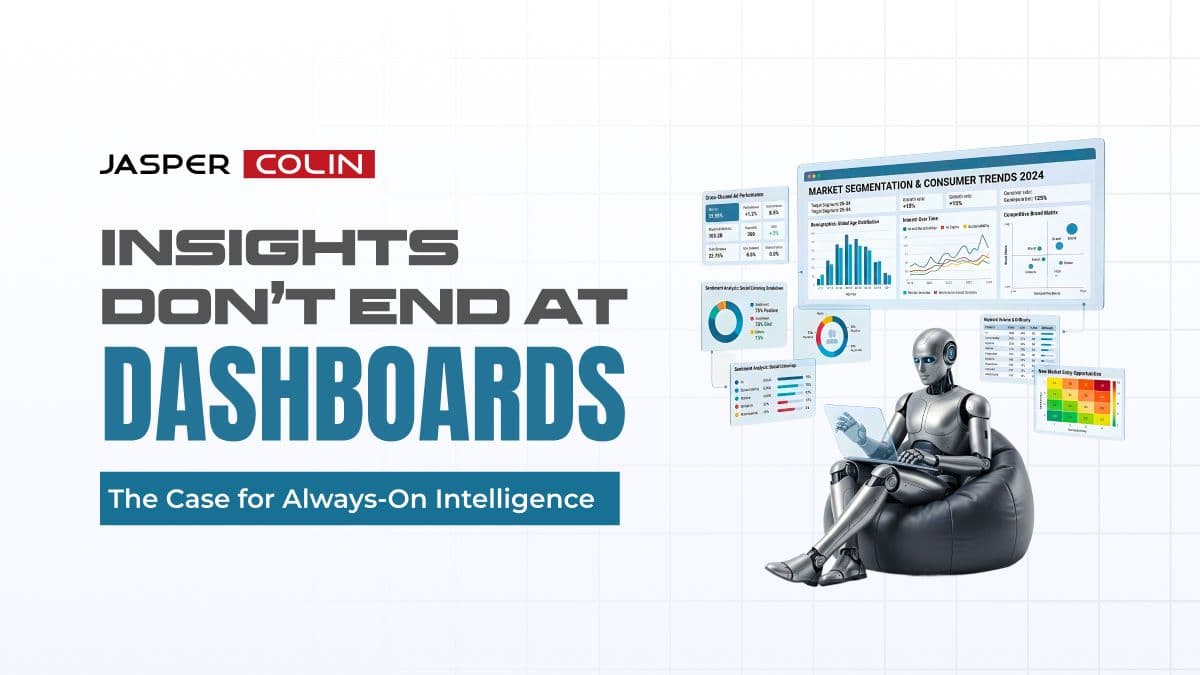
The Illusion of Completion
When a research project is complete, there is a certain sense of accomplishment. The report gets sent around. The dashboard goes live. The deck is presented, and it ends with a slide of recommendations, and the audience nods. Done.
But the market kept on going while you were creating that presentation.
Attitudes/sentiments changed in the three weeks it took to design, execute, and report the research. Your competitor launched a new product the day of your readout. The behavioral data that was gathered during the research period reflected a snapshot that is now history.
This is a common scenario across industries and across functions. Research is commissioned, conducted, and reported. Then it gets filed. The company continues on until the next trigger, typically a campaign, a product failure, or the annual planning cycle, and the cycle begins anew.
The misalignment is obvious. Decisions happen every day. Expectations change every three months. Market conditions shift overnight. But intelligence notifying those decisions was designed for a moment that no longer exists.
Why do we view intelligence as a project, rather than a system?
Why Research Stops Too Soon
It's not that companies aren't staffed with good researchers and powerful tools. The problem is structural, and it has four manifestations.
All these issues feed on each other. Reactive commissioning means there is no longitudinal baseline. Static outputs hide the lack of continuous sensing. Lagged delivery erases strategic timeliness. Data fragmentation prevents synthesis.
From Output to Infrastructure
The traditional view is that insights are a product. Research delivers reports, dashboards, and presentations. The output is the property of the client, and the research team is moving on to the next project.
This representation is wrong, and it costs a lot of money.
Insight is not a product. It is infrastructure. Just as companies build customer relationship management (CRM) systems to manage customer relationships in real time rather than audit their customers annually, they should build intelligence systems that run all the time rather than run a study every three months.
Always-On Intelligence is the design philosophy. It is not a product or a process. It is an approach to design that considers knowledge as an accumulation rather than a reset. It is about creating systems that adapt to change, rather than capturing and storing snapshots.
The shift in mental model is from reporting to sensing. Reporting answers the question "what happened?" Sensing answers the questions like "what's changing, why is it changing, and what will happen next?"
Companies that make this transition stop viewing research as a cost and begin viewing it as a decision layer. The intelligence function moves from backroom to front room.
What Always-On Intelligence Looks Like
There are three parts to an always-on system. Each does something the others cannot.
1. The Memory Layer: Longitudinal Tracking: Most research captures a moment. Longitudinal tracking captures a trajectory.
When you ask the same questions of the same people over time, using the same methods and similar samples, you can see things that you can't see in cross-sectional studies. Satisfaction scores are less meaningful when viewed in a snapshot than when they are viewed as a trajectory over the past six months and where they are heading. Brand perception scores are more meaningful when you can see how they changed in response to events.
This is not simply repeating the same survey. It is about creating a tracking design: setting baselines, deciding what to track and how frequently, and putting in place the processes to compare data across time without introducing methodological bias. It does not produce just a report. It is a continuous history of customer, market, and competitor movement.
Longitudinal tracking does something else that point-in-time research cannot: it separates signal from noise. One wave showing an increase in dissatisfaction may be an aberration. Three waves in a row are a cause for concern.
2. The Reality Layer: Behavioral and Passive Data: People say what they think they do. Behavioral data shows what they do.
There is a problem with surveys and focus groups: they are self-reported. Participants remember what they did, they report what they think others want them to do, and they talk about what they intend to do in the future. This is not a problem with the study design; it is a problem with human nature. Humans are poor storytellers.
This is where behavioral data comes in. Electronic interaction logs, product usage, transaction sequences, and engagement metrics record real choices as they occur, free from the biases of recall. When a customer says they want premium products but buys on sale, you see the difference between expressed and actual preference.
When behavioral data streams in real-time and is integrated with attitudinal data in the same intelligence system, you can see that gap. You can see not only what customers say they want, but what they do reveals what they want. This is more predictive than either data type alone.
3. The Meaning Layer: Primary Research: The first two components generate patterns. Primary research explains them.
A tracking system may tell you that a certain segment of customers has been dissatisfied for the past six weeks. A usage study might show that this segment altered its usage pattern. Neither tells you why. Without the why, you cannot act because you don't know if it is a problem with the product, price, service, competition, or something else.
Primary research, whether it be qualitative interviews, targeted surveys, ethnographic studies, or co-creation workshops, provides context that data streams lack. It adds human color to quantitative trends. It tells why, the rage, the pain that underpins a metric trend.
Primary research is not a one-off study in an always-on system. It is an active component that kicks in when the tracking or behavioral layer raises an issue. The brief for a qualitative study is not a client brief; it is a data trigger.
Insight to Foresight: The Business Impact
The case for always-on intelligence is not methodological. It is commercial.
The Organizational Shift Required
The shift to always-on intelligence is not a process shift. It's a shift in the relationship between several elements of the organization.
Going Forward
The research industry has spent decades perfecting the study. The methodology has improved, the sample has improved, and the analysis has improved. All of this has led to better snapshots.
But a better snapshot is still a snapshot.
The move from episodic to continuous is not an improvement of the status quo. It is a different practice. It needs different infrastructure, different team structures, different budget models, and a different relationship between the intelligence function and the decisions it is meant to inform.
At Jasper Colin, the work we do in designing integrated intelligence ecosystems, multi-method research programs and continuous insight systems is based on a simple premise: the purpose of research is not to deliver a report. It is to reduce uncertainty for decision-makers. And that requires systems that run as long as decisions do.
Which is to say: always.
Fast Turnaround with Survey Automation for Political Research

Energizing the Future : Utilities at the Crossroads of Transition

From Anchors to Insights | Data-Driven Strategies for the Luxury Yacht Market